Be yourself; Everyone else is already taken.
— Oscar Wilde.
This is the first post on my new blog. I’m just getting this new blog going, so stay tuned for more. Subscribe below to get notified when I post new updates.
Be yourself; Everyone else is already taken.
— Oscar Wilde.
This is the first post on my new blog. I’m just getting this new blog going, so stay tuned for more. Subscribe below to get notified when I post new updates.
On March 11, 2020, COVID-19 was declared a pandemic (World Health Organization, 2020). Did you believe this virus would take over the world to the extent that it has? In late February, some Canadian companies started taking precautionary measures to avoid and protect their employees against COVID-19 prior to Government enforcement. Companies like Manulife Financial Corp. created rules requiring employees to self-quarantine for 14-days upon coming home from travelling. Many employees were given this instruction and were unaware of the rights they had regarding pay and benefits. It can be concluded that employers should have the right to force employees not to return to work for 14-days when given supporting evidence that the employee could’ve been in contact with the disease.
Employers have the duty to “promote a safe and healthy workplace” (Government of Canada, 2019). Since COVID-19 is a highly contagious and potentially life-threatening disease, a workplace is allowed to ask an employee to stay home when given supporting evidence. This is usually done to protect their other employees and do their part as a company to “flatten the curve”. Based on the facts of the article, I agree that employers need to follow the correct protocol when asking employees to stay home to avoid improper discrimination. This can include discrimination regarding disability, ethnicity, and place of origin. Decisions need to be made based on facts rather than assumptions. Employers should ask all employees if they have travelled outside Canada within the past 14 days, or have been in close contact with individuals who have gone to Europe or China (the epicentres of the pandemic). This prevents any discrimination that could occur and allows for the employer to give out equivalent instructions. Laid out by professionals, employers are protected in regard to abiding by the Human Rights Code with respect to Discrimination.
Concerning pay, employers need to review the individual employment contract of each employee, or collective bargaining agreement when in a union setting. These agreements and contracts will have information regarding the protocol that has already been established. If not, I believe that employers should pay employees for this 14-day quarantine since the leave is mandatory for the employee but a decision the company has made. Once the Government sets laws requiring businesses to close, I think employees should not have to be paid by the company anymore since the closure is out of the company’s control. However, employers should alert employees of the options they have regarding employment insurance.
Overall, companies need to take all precautionary measures when dealing with the health and safety of their employees. Employers should pay all employees that are required to stay home since it is a choice the company is making, but once it is out of the company’s control, I believe pay should not be required. When staying open, companies should take all precautionary measures such as informing employees how to correctly sanitize, wash their hands, and cough/sneeze to prevent the spread of the disease.
References
Article: Collie, M. (March 4, 2020). Coronavirus: What if your employer asks you to self-quarantine? Global News. https://globalnews.ca/news/6628914/coronavirus-work-from-home/
Government of Canada. (August 26, 2019). Workplace Safety. https://www.canada.ca/en/employment-social-development/services/health-safety/workplace-safety.html
World Health Organization. (March 27, 2020). Rolling updates on coronavirus disease (COVID-19). https://www.who.int/emergencies/diseases/novel-coronavirus-2019/events-as-they-happen
As of December 4, 2019, the Elementary Teachers’ Federation of Ontario (ETFO) began a series of one-day walkouts protesting the Government not fulfilling the requests of the Union. The ETFO is asking for a 2% increase in wages while the Government is only offering 1%. The other demands the ETFO has is increasing the support with regards to students with special needs, addressing violence within schools, and preserving full-day kindergarten. The Government is not accepting the offer causing the ETFO to strike for over a month now. With negotiations being held weekly, most of Ontario is waiting patiently for a deal to be met.
The Government should compromise increasing the wages of elementary school teachers by 1.5% while investing the other 0.5% requested, and the money that was saved from the strikes into the other issues presented by the ETFO. This will allow for a compromise to be met between both parties.
The article discussed the topic of the “Government bribing parents”(1) by giving money to families who have children in elementary school, and students 21 and under with special needs who are in a publicly funded program. On average, this funding costs around 48 million dollars daily, which is 12 million dollars cheaper when comparing the money, the Government spends on teachers and support staff wages. The Government is funding this money to the parents of young students to “provide some relief to families.” The Union interpreted this action as a bribe, creating more conflict between the parties.
I believe that instead of paying out families for childcare during the strike, the money should be put towards funding for these programs the ETFO is requesting. The Government has saved millions of dollars due to the strikes which can be invested into the system, rather than used to spark interests of parents.
I personally believe that the Government should accept the requests of the ETFO because Ontario’s education is a necessary and globally prestigious industry Canada has been recognized for (2). With this being said, I do not think it is realistic to fund all of these requests to the ability the ETFO wants since citizens voted in a Conservative Government that promised to cut public funding on industries such as education.
If we look at Ford’s fourth quarter-hourly wage growth by occupation, it is identified that the Government has increased wages in all other occupational groups by an average of 3% but education, which has been cut by 0.9% (Refer to Image 1) (3). By the Government agreeing to
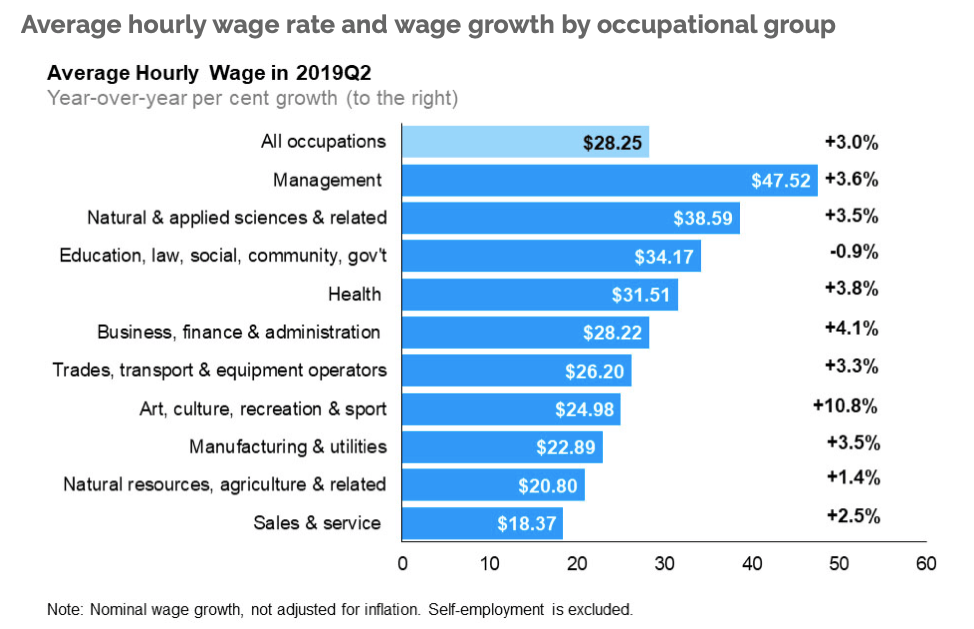
increase wages for education workers by 1.5%, I believe this is a reasonable compromise between what each group is asking for. The Government needs to realize the difference between all other occupations compared to education is unreasonable and needs to be fixed. Image 1
Thank you for reading my opinion on the topic. I am excited to hear your stance on the subject and answer any questions if you have any!
Claire Grant
(1) CBC News. (January 15, 2020). Ontario public elementary school teachers set to begin rotating strikes on Monday. CBC News Toronto. https://www.cbc.ca/news/canada/toronto/etfo-public-teachers-strike-1.5427368
(2) U.S. News. (n.d.). Best Countries for Education. U.S. News and World Reports. https://www.usnews.com/news/best-countries/best-education?slide=4
(3) Government of Ontario. (n.d.). Ontario Employment Reports. Ontario. https://www.ontario.ca/document/ontario-employment-reports/april-june-2019?share=a52caeb0-ae26-11e9-b1d7-536843a29b1d
Hi everyone,
My name is Claire Grant. I am in my second year of Commerce here at Queen’s University. I grew up in London, Ontario, with my parents and brother. One thing I’m really passionate about is the executive I am on. I’m an International Outreach Coordinator on a club called Queen’s Commerce Service Intuitive. The executives and trip team prepare throughout the year to go on a service trip on the February reading week. This year we are going to Antigua, Guatemala to help a family renovate their living arrangements. Other than that, I usually fill my spare time hanging out with my housemates and watching Netflix. My favourite show is Gilmore Girls and I frequently find myself re-watching it. One fact about me is that I love to travel, and I’m super excited to have the opportunity to go on exchange next year. I’m hoping to be assigned to one of my three top school choices which are: ESADE in Barcelona, Spain, WU in Vienna, Austria, and Nova Business School in Lisbon, Portugal. This is definitely an experience I cannot wait for in the upcoming school year.
I decided to take EMPR 200 as an elective because I think employment relations is an essential topic to be educated in, no matter what area of the workforce you want to go into. Most people are going to work for a corporation, and knowing your personal rights as an employee is crucial. The topics I’m most excited to learn about in the course are managing employees, labour and employment law, and collective bargaining. I think these topics will be essential to my future job, which makes learning about these areas very interesting.
I am super excited for what’s to come in this class and getting to know you all.
Claire

Have a WordPress.com account? Log in now.

